
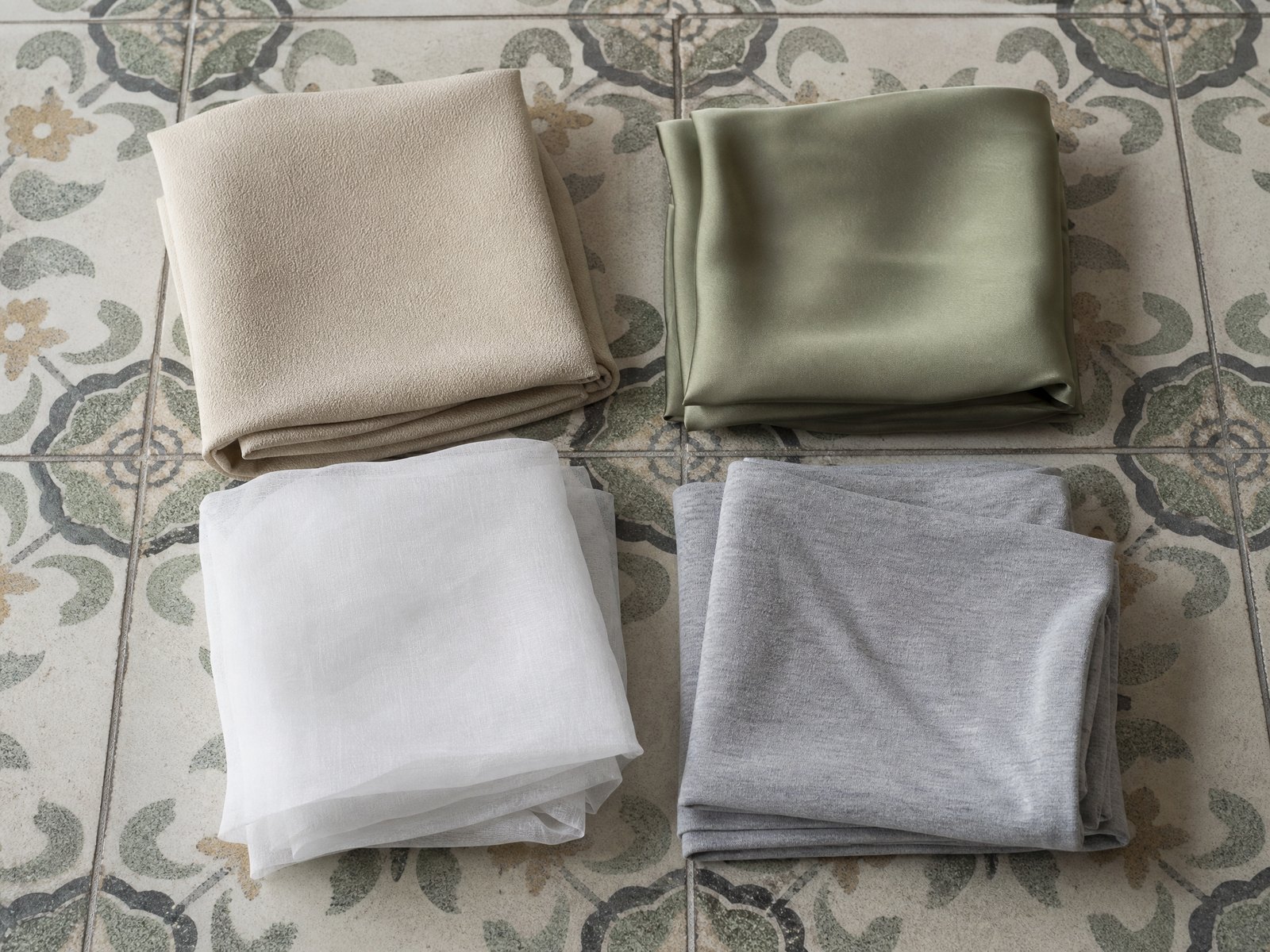
Everything we cut has to do one thing well: hang. A floor-length garment has a metre and a half of cloth pulling down from the shoulder seam, so fibre choice decides whether the finished piece reads as a clean column or as a bag. Below is what we buy, what each fabric is good at, and what you give up in exchange. Every product page names the exact composition and weight for that style.
Viscose crepe, 140 to 165 gsm
The backbone of the range and the reason our abayas swing rather than cling. Crepe is a high-twist yarn woven to give a dry, faintly sandy surface, so it does not sit against the leg with static. It drapes in soft vertical folds, takes deep matte colour beautifully — our Brick Rust and Ink Navy are at their best here — and it is completely opaque at this weight. What you give up: viscose is weak when wet, so it needs a gentle cool wash and no wringing, and it will crease if you sit on it for two hours. It also relaxes slightly in length over a season of wear, which is why we hang finished pieces before folding.
Tencel lyocell twill, 170 to 195 gsm
Our choice for trouser sets and structured robes. Lyocell is a wood-pulp fibre spun in a closed-loop solvent process, and it gives weight and body without the stiffness of a hard cotton twill. It resists creasing far better than viscose, comes out of a wash almost smooth, and feels cool against skin, which matters on a garment worn all day. Trade-off: it costs noticeably more per metre, and it takes dye slightly deeper than viscose does, so a lyocell piece can read a shade darker than a crepe piece in the same colour.
Washed linen, 180 to 210 gsm
Summer cloth. Stone-washed before cutting so it arrives soft rather than board-like, and it keeps softening. Linen breathes better than any other fibre we use, wicks moisture, and dries fast. It is also the most honest fabric on the site: it creases at the elbow and behind the knee within an hour of wearing, and no amount of pressing prevents that. If crumple bothers you, buy lyocell. If it does not, linen is the most comfortable thing to wear in July under full coverage. It lightens gradually with washing.
Cotton poplin and cotton voile
Poplin at 110 to 130 gsm gives shirt dresses their crispness and holds a collar and placket properly. It is durable, easy to wash hot, and cheap to replace — but it wrinkles and it has no drape, so we keep it to structured shapes rather than floor-length columns. Voile at 70 to 85 gsm is used only for square headscarves, where its lightness lets you fold and tuck without bulk. Voile is semi-sheer by nature, which is fine on a scarf and unacceptable on a garment, so we never cut bodies from it.
Modal jersey, 200 to 230 gsm
For jersey wrap headscarves and some undersleeves. A dense modal knit with a few per cent elastane grips itself, so a wrap holds without pins, and modal has a fluid, matte surface that does not shine under daylight. It is the softest thing we sell. The cost is pilling at friction points over time, and a sensitivity to fabric conditioner, which coats the surface and destroys the grip.
Silk-touch georgette
A fine filament georgette used for sheer overlays and tiered dress skirts. It moves in air in a way nothing else does. It is also thin, so it is always cut over an opaque lining, and its seams are French-seamed because raw edges show straight through.
Wool-blend suiting
Winter trouser sets and a small number of robes, in a wool-rich blend around 260 gsm. Warm, it holds a pressed leg crease for weeks, and it recovers shape overnight on a hanger. In exchange it wants dry cleaning or a careful cool hand wash, and it is heavier on the shoulder than anything else here.
Linings and trims
Linings are cupro or fine viscose, never polyester, because a lining that does not breathe undoes the point of a breathable outer. Buttons are matte corozo or polished horn. Snaps are steel with self-fabric covers. Thread is matched by series. If you need a full breakdown before ordering, write to support@ruqyahi.shop; compositions per style are listed at https://ruqyahi.shop/materials.
RUQYAH LTD
Company number 17291326, registered in England and Wales.
Registered office: 3 Pasteur Terrace, Credon Road, London, E13 9BH, England
Email: support@ruqyahi.shop
RUQYAH LTD is not currently registered for VAT. No VAT is charged on the prices shown on this website.